
Felwine Sarr the Senegalese intellectual, economist, writer, has produced many cultural and academic works. His works contribute to affirm black identity and cultural value, celebrate African heritage and decoloniality. He has done this by writing books such as Afrotopia, promoting epistemic sovereignty and appearing in numerous academic podcasts. In 2018, along with French art historian Bénédicte Savoy, together they wrote the infamous 252-page document ‘The Restitution of African Cultural Heritage. Toward a New Relational Ethics’ giving an outline of restauration of African art works back to Africa. The document received mixed reception from panic to approval which was pedalled by the media. This highlighted the influence of the media on dictating narratives which skewed and oversimplified the original message. By examining two articles on the topic from mainstream media outlets, one from the Nigerian Guardian and one from France24, we will attempt to answer the question, is the media helping or hindering his works and objectives?
Sarr’s decolonial vision.
Sarr’s works outline a decolonial project centred on reclaiming African epistemic and cultural autonomy. Drawing on works from the likes of Frantz Fanon, Aimé Césaire and Léopold Sédar Senghor, he calls for the decolonisation of knowledge and cultural ownership, arguing that Africa must think from itself rather than through Eurocentric lenses. As he writes in Afrotopia, it is necessary for “African countries to create a political, economical, and social project that is derived from their own socioculture and emanated from their own mythological universe and worldview”. (Sarr, 2019) His academic works provide the ethical foundation for his restitution work and brings to light the notion that restitution is not just physical return of objects but an ethical repair. It restores narrative agency to African nations, by the return of cultural works, can reclaim their histories. His work also contributes to a re-imagining of African futures beyond Western models of progress to help prevent ex-colony nations play ‘catch up’ with the West.
Media dynamic: a battleground for intellectuals.
To understand why media remains a site of struggle for African thinkers, it is useful to begin with Frantz Fanon, who reveals how colonial power shapes perception, language, and representation. Frantz Fanon in his 1952 book black skin, white masks affirms that colonialism and racism impose a white standard of humanity, by extension the media operates through the lens of the coloniser, operating in western academic frameworks which are based on western epistemological dominance. (Creary, 2012) Because African journalism was established during colonial rule, it inherited Western structures, values, and news priorities, which continue to influence how Africa is represented both internally and externally. The media’s role in African society, still based on western frameworks which pits African as lagging behind Europe demonstrate the need for decolonization of the media narrative.
Pierre Bourdieu and the media trap.
For French intellectual Pierre Bourdieu, media spotlight comes at the cost of losing complexity and autonomy for nuanced ideas. Or as he put it “Fast thinking is encouraged, and there is no time for distance, reflection, or complex thought.” This subtly imposes dominant cultural values under the guise of neutrality. The media dictates what is shown, how it’s shown and what is omitted and can therefore reinforce established cultural norms and narratives. This reinforces the hegemony, power dynamics set by the west, pitting colonised nations to catch up to their norms, subconsciously continuing a colonial hierarchy. (Bourdieu, 1998)
Media for liberation.
While Fanon and Bourdieu diagnose the problems, francophone intellectuals Aimé Césaire and Ousmane Sembène suggest how media can be strategically reclaimed to challenge colonial narratives from within. Fanon, although through a more psychoanalytical lens, highlights the issues regarding the colonial hegemonies established and reinforced by the media. However, French intellectual Aimé Césaire observed the positives of this medium as a tool for claiming hegemony and propagate ideas that dismantle colonial structures. In his discourse on colonialism (1950) he condemns colonialism but begins to distinguish technology itself from colonial exploitation. ‘Technology is not the enemy, colonial use of it is.’ He further argued that colonised societies must become creators, not passive consumers, of knowledge and technology. By adapting to this medium he was able to reach more masses more effectively than through printed text.
Similarly, Senegalese film maker and writer Ousmane Sembène adopted cinema as a tool for decolonisation. He viewed literature to be less accessible to the masses as it only reached the elite, literate audiences. Film acted as a mass communications apparatus comparable to radio in Fanon’s Algeria, but with greater visual and emotional impact. Sembène did not reject modernity, he reclaimed it, arguing that technology is not inherently Western, as argued by Fanon, but liberating when controlled by African people. He envisioned a future in which African societies have their own media sovereignty, free from the framework and epistemologies of the west and by doing so, not be compared to, but stand alone as their own independent agents. (Curto, 2016, p. 151)
The Infamous Restitution Letter.
The Restitution of African Cultural Heritage: Toward a New Relational Ethics” (2018) policy and philosophical report commissioned by French President Emmanuel Macron layed out a framework for returning African cultural objects that were taken during the colonial period and are now held in French (and other European) museums. It keeps a grounded tone giving a historical context of which the artifacts were taken through force during the colonial era. It seeks not only to restore the artworks to their country of origin but acts as a treaty for new relational ethics. In which it seeks to move forwards beyond old colonial hierarchies toward mutual recognition and cooperation. Affirming that restitution should create dialogue, not division, and to rebuild trust between Europe and Africa. (Sarr and Savoy, 2018) It gives a clear well-thought-out five-year plan of the gradual restoration of cultural artworks back to their country of origin. It provides legal suggestions as to do this pragmatically taking into account infrastructure, finance and human resources.
Felwine Sarr’s Case: Different media representations.
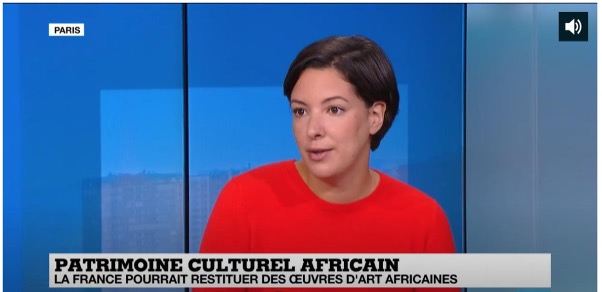
Following the publication of the report, the mass media extensively covered it, each putting on their spin on it. The France 24 article Les œuvres d’art du patrimoine africain bientôt restituées ? Focused more on the complications and ramifications with a somewhat resistant tone to restitution. The article recalled that earlier requests from Benin had been rejected on the basis of the Quai d’Orsay’s legal position that cultural goods were “subject to the principles of inalienability, imprescriptibility, and immunity from seizure.” Furthermore Art dealers and collectors denounced the Sarr–Savoy report as “inapplicable,” with lawyer Yves-Bernard Debie claiming it was “inoperative” because art-market actors were not consulted and that 90% of African goods were indeed acquired through legal or good faith. While Macron would ultimately decide, France 24 foregrounded anxieties through questions such as whether returning objects would “empty French museums” or reopen “debates and wounds linked to colonisation.” (Boko and Mufson, 2018)
This example exemplified the overarching narrative that media outlets took from the report: that France must “give everything back.” This framing not only misrepresented the content but ignited a sense of political defensiveness, particularly among European art collectors. Sarr and Savoy repeatedly had to correct the narrative. As Sarr stated in an interview with Deutsche Welle, “The idea is not to empty museums… It’s a lot more complex and serious than that.” (Brown, 2019) He emphasised that African nations were not demanding the wholesale evacuation of European museums, but the return of a limited number of highly symbolic objects. Savoy similarly noted that none of the 150 African interlocutors consulted had proposed total removal of collections. Yet, as the authors observed, some critics and media voices oversimplified their ideas to gain the public’s attention and create a narrative.
This misrepresentation demonstrates a wider problem: when intellectual work enters the media ecosystem, it is vulnerable to reduction, misconstructions or even political weaponisation. This framing reflects a reluctance to confront historical injustice and a preference to avoid unpacking colonial responsibility, thus illustrating media’s role in protecting dominant narratives.
Such statements reveal how vested interests seek to maintain colonial-era hierarchies by questioning African ownership and legitimising Western possession. Even public opinion featured paternalistic undertones: interviewees at the musée du quai Branly doubted whether African countries had the capacity to preserve returned objects, reinforcing a civilisational hierarchy. As Marie-Cécile Zinsou argued, this reflects a continued “condescending, paternalistic and post- colonial” gaze towards Africa. (Boko and Mufson, 2018)
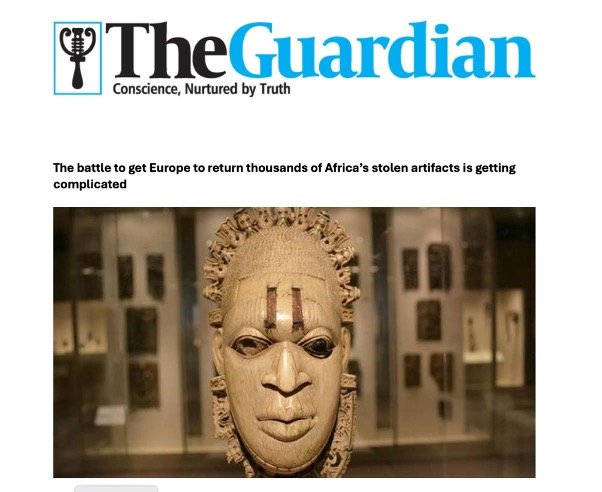
By contrast The Nigerian guardian article sets the tone with a historical context of colonialism, pillaging, looting and how that has resulted in the prevention of prosperity for African nations today. This emotive language helped establish a tone of moral authority, showing restitution as part of a long continuum of colonial violence and that restitution should be a moral and ethical obligation rather than a ‘gift’.
Further uses of emotive language “Africa has been disturbed, disrupted, invaded and looted…”, “wickedly desecrated” to generate moral outrage further building the narrative that Europe’s actions as unethical and restitution is a moral imperative. The use of the rhetorical question ‘why does the Western world find it so difficult to return these objects’ This forces the reader to face an uncomfortable truth, it does not want Europe to be evasive on the matter as it often tries. The tone comes across as hyperbolic which not only emphasise the gravity and consequence of this situation, but clearly positions this article in the camp of it’s important to give everything back. (Sijuade, 2018)
A striking contrast emerges when comparing reactions across media landscapes. By and large, French and European outlets largely framed the report through fear and cultural defensiveness, treating restitution as a threat to national heritage and identity. By contrast, African media tended to receive Sarr’s letter as a catalyst for intellectual empowerment and cultural repair, highlighting restitution as an opportunity for ethical progress, sovereignty, and historical justice.
Two Audiences, Two Narratives: The Battle for the Restitution Story.
Both news reports reported the case with an agenda of their own. France24, although attempting to portray a professional neutrality, gave a lot of attention to the complications to the restoration process, thus coming across as reluctant to correct old wrongs. As for the Nigerian Guardian it made its stance quite clear: deploying emotive rhetoric and foregrounding the historical violence of European colonialism in Africa.
In both cases, the nuances, balance and complexities of the original report were severely overlooked. The media acted as a tool to push an agenda their societies tend to consume. Tying into Bourdieu’s theories that mass media simplifies and distorts public debate and prefer emotional reaction over reasoning. And exemplifies his theory that complex ideas are reduced to soundbites to fit media formats. The result: media lowers the standard of public thought and prevents real critical analysis.
Despite its flaws, has Sarr benefited from adapting the media as a tool to push his works and ideas? It is difficult to say, the media is clearly a weapon to push agendas, muddy waters and undermine academic work. However, there is no doubt that media engagement has allowed him to reach a global following. However, just as Fanon mentions, under the current framework and hierarchy structures that rule the media, and until nations can break from its framework. The media can easily paint narratives and destroy academic integrity.
Bibliography:
- – Bourdieu, P. (1998) On Television. Translated by P. P. Ferguson. New York and London: The New Press and Pluto Press.
- – Creary, N.M. (ed.) (2012) African Intellectuals and Decolonization. Athens: Ohio University Press.
- – Curto, R.N. (2016) Inter-Tech(s): Colonialism and the Question of Technology in Francophone Literature. Charlottesville: University of Virginia Press.
- Dapo Sijuade (2018) ‘Necessity for the restitution of Africa’s cultural objects’, The Guardian (Nigeria), 7 January. https://guardian.ng/art/necessity-for-the-restitution-of-africas-cultural- objects
- Hermann Boko and Claire Mufson (2018) ‘Les œuvres d’art du patrimoine africain bientôt restituées?’, France 24, 23 November. https://www.france24.com/fr/20181123-france- afrique-benin-restitution-patrimoine-africain-oeuvres-art-retour-colonies-macron
- – Kate Brown (2019) ‘“The Idea Is Not to Empty Museums”: Authors of France’s Blockbuster Restitution Report Say Their Work Has Been Misrepresented’, Artnet News, 24 January. https://news.artnet.com/art-world-archives/restitution-report-critics-1446934
- – Sarr, F. and Savoy, B. (2018) The Restitution of African Cultural Heritage: Toward a New Relational Ethics. November. [Report commissioned by the President of the French Republic].
- – Sarr, F. (2019) ‘Against the Tide’, in Afrotopia. Minneapolis: University of Minnesota Press, p9.
Further reading:
The Economist (2019) ‘The clamour to return artefacts taken by colonialists’, The Economist, https://www.economist.com/international/2019/03/28/the-clamour-to-return-artefacts- taken-by-colonialists
– Fanon, Frantz, and Anthony Appiah, Black Skin, White Masks, , trans. by Richard Philcox, First edition, New edition (New York: Grove Press, 1952)
- Fanon, Frantz, and Anthony Appiah, Black Skin, White Masks, , trans. by Richard Philcox, First edition, New edition (New York: Grove Press, 1952)
- Hiddleston, Jane, Decolonising the Intellectual : Politics, Culture, and Humanism at the End of the French Empire (Liverpool: Liverpool University Press, 2014)
- Sarr, Felwine, African Meditations, ed. by Drew Burk (Minneapolis, MN: University of Minnesota Press, 2023) <https://search.ebscohost.com/login.aspx?direct=true&scope=site&db=nlebk&db=nlabk&A N=3189551> [accessed 5 November 2025]
– Hiddleston, Jane, Understanding Postcolonialism (Hoboken: Taylor and Francis, 2014) <https://public.ebookcentral.proquest.com/choice/publicfullrecord.aspx?p=1886877> [accessed 5 November 2025]
 Intellectuals and the Media in France