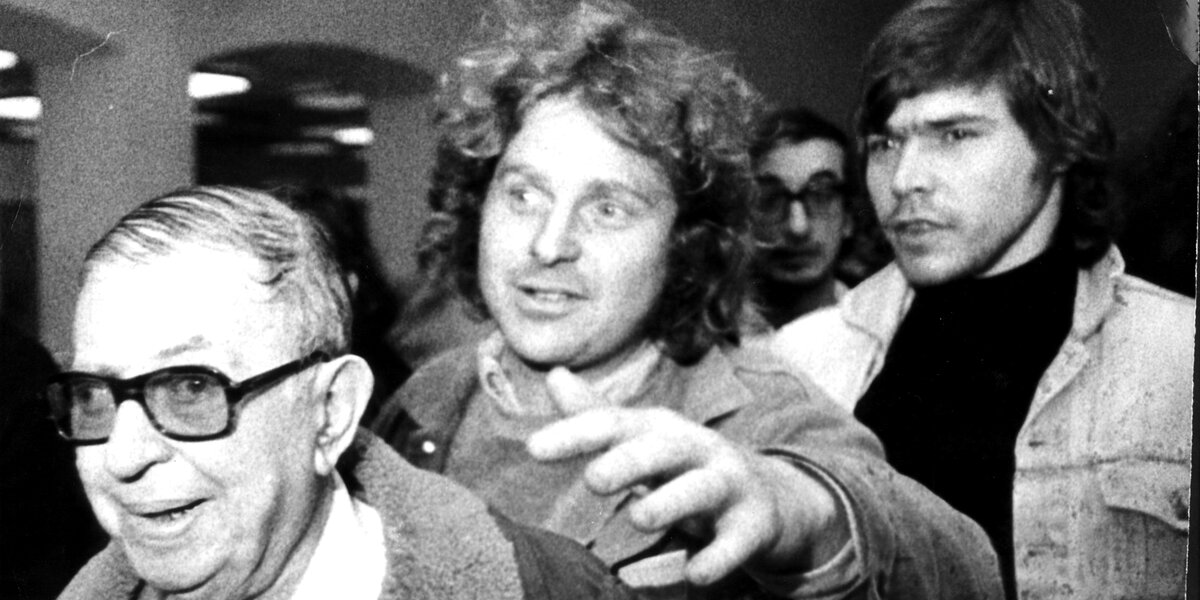

In a lecture given in 1946, Jean-Paul Sartre stated “Thus, the first effect of existentialism is that it
puts every man in possession of himself as he is, and places the entire responsibility for his
existence squarely upon his own shoulders.” (Sartre, 1946). In saying this, Sartre is capturing the
paradox of the modern intellectual: public communication is essential to take the responsibility that
comes inherently with the concept of freedom. This idea is prevalent throughout Sartre’s works,
and was a theme discussed in an interview conducted by Sartre in the midst of the May 1968
student and worker protests in France, as he stated: “But now that speech has been suddenly freed
in Paris, it is essential first of all that people should express themselves.” (Cohn-Bendit, 1968). The
interviewee was Daniel Cohn-Bendit, a leading figure of the student movement in May 1968, noted
for outspoken criticism of institutional authority and his role in mobilising students at the University
of Nanterre. He became a symbol for political spontaneity and rebellion of the youth, as well as the
left due to not only his political views but his red hair. The unity of classes was shown in his quote “I
know that the only chance of resuming the struggle is to put an end to the division between
intellectuals and workers.” (Cohn-Bendit, 1968). The discussion between the two was published in
Le Nouvel Observateur and offered the insights and opinions of both men, who were united in their
concern for political and social change. This piece of media offers valuable insight into the effects of
inserting intellectual debate into a time of national upheaval, revealing the intersections of
journalism and philosophy, as well as Sartre’s interest in the hunger for revolution that younger
generations possessed and how they would exercise freedom and responsibility during the
hardship of revolt. As it was later observed by various commentators, Sartre was attempting to
rethink the role of revolutionary vanguards and communist parties with Cohn-Bendit (Bjork-James,
2023). By studying the interview, we will understand how it was a capture of the unity between
philosophy and activism in a new media format, illustrating a major change in the role of the
modern intellectual.
To give additional context to the conducted interview, the month of May 1968 faced huge strikes
due to class segregation and authoritarian university structures. The strikes were led by students
and workers alike, who seized and barricaded the University of Nanterre, the Sorbonne and
factories across France. The strike of ten million workers caused the near paralysis of state
authority and effectively shut down the French economy, whilst students took over institutions,
creating a new stage for public debates, teach-ins, and varied artistic performances. “A student
agitation precipitating, a massive general strike affecting some ten million workers, more than half
of the nation’s entire labor force. This in turn provoked an acute political crisis that brought General
de Gaulle, and with him the Fifth Republic, to the verge of collapse” (Silvera, 1971, p. 341). The
Latin quarter in Paris became the heart of the revolution, where police made the arrests of
hundreds of students, sparking even further outrage.

Due to his expulsion from France by the French government after labelling him as a ‘foreign
agitator’ and accusing him of inciting political and social unrest, Cohn-Bendit was obliged to remain
in Germany due to his German nationality. The interview therefore took place in Frankfurt during
the events in May, where Cohn-Bendit had continued his leftist activism by becoming involved with
a radical leftist activist milieu named Sponti. It was published in Le Nouvel Observateur on May 20, 1968.
Known for his concepts of engagement and existentialism, Jean-Paul Sartre was France’s most
prominent public intellectual at the time, especially resonating with leftists and supporters of anti
colonialism. Sartre even stated once « La morale, voilà, en effet, quelle est ma préoccupation
dominante, et telle elle fut toujours » (Boschetti, 1985, p. 81). The role of Sartre in the revolt was
that of a mediator between the generations, as the interview had representation of the older
generation through Sartre and the young, radical generation, which would help his platform reach a
wider audience. He was prominent in expressing his political views and sharing his philosophical
ideas in the media through newspapers, magazines and radio, and was willing to share his stage
with a wide range of demographics, showing his interest in appealing to younger generations by
conducting the interview with the champion of the youth.
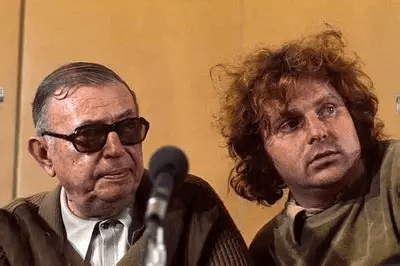
« Autrui est le médiateur indispensable entre moi et moi-même. » (Sartre, 1943), highlights the
inescapability of the publicity and, furthermore, the scrutiny that comes with thought and action.
Since the creation of the concept of philosophy and intellectuality, works produced by philosophers
have always been subject to examination and criticism by the common people, and fewer
philosophers of recent generations have had their own ideas tested as publicly as Jean-Paul Sartre.
His notion that freedom was an experiential feeling rather than a codified practice was solidified at
a time of unprecedented social upheaval during the student revolt of May 1968 (Sartre, 1968). This
revolt was particularly ground-breaking as it shifted what was output in the media for the purpose
of protest or revolt, evolving from long styled letters (Zola, 1898) to fast paced television and radio
interviews and images and headlines that dominated a whole front page. Due to the media’s
requirement of transitioning to immediacy, brevity, and visibility through the protests, intellectuals
with leftist views that aligned with those of the revolting student population, such as Sartre, used
this new media exposure to turn the streets into his stage through the use of propaganda,
interviews and manifestos, using the rhetorical strategy of ethos to force the agenda he believed in
due to his credibility with the french population to aid the cause of the students.
Sartre’s interview with Daniel Cohn-Bendit exemplified the transformation, as it ensured quick and
easy accessibility to works of philosophical performance and intellectual discourse to the masses.
The publication of the interview in Le Nouvel Observateur was particularly effective, as the medium
had a high readership and therefore held a great deal of communicative power, and the ability to
convey complex ideas succinctly, something that was central to this transformation in media
(Barthes, 1977). Slogans, posters and manifestos were also used to perform leftist agendas,
transforming the act of intellectual engagement into a collective experience, aiding the promotion
of philosophical ideas to a large, impressionable audience. In doing so, Sartre’s idea that freedom is
a feeling rather than a practice is realised through the process of thought and action being merged
and taking to the streets make freedom a phenomenon in lieu of an abstract principle.
Sartre’s concepts of reflection and engagement are evident when discussing the choice of medium,
as an interview allows him to use rhetorical appeals, specifically pathos, through a more relatable
form of media to the youth of the 1960s. The interview as a genre alters from the traditional
medium of essays or letters published by philosophers, as it prioritises immediacy and accessibility
over abstraction. By engaging in conversation with Cohn-Bendit, a well-liked figure in France at the
time, he transformed what would normally be a lecture into a dialogue that resonated with the
youth, aligning with the new concept of intellectual discourse in the media becoming performative
and public. The younger generation is engaged in existential ideas by combining emotional
resonance with his established stature as an intellectual (ethos), as well as being able to resonate
with Cohn-Bendit’s youthful energy and emotional delivery (pathos). Sartre also directly appeals to
the youth through their naïve sense of possibility and hope; “Quelque chose est sorti de vous, qui
étonne, qui bouscule, qui renie tout ce qui a fait de notre société ce qu’elle est aujourd’hui. C’est ce
que j’appellerai l’extension du champ des possibles.” (Sartre, 1968, cited in Orain, 2018, p. 125).

(possibly taken by Guy Kopelowicz, 1968).
The way that the interview was distributed by Le Nouvel Observateur also shaped the new
rhetorical distribution of the medium, with brevity, clarity, headlines and visibility being the new
focus on how medium is supposed to be delivered. In this shift of media production, the ethics of
speech were also redefined along with the aesthetics of intellectual dialogue, where parrhesia was
prevalent, aligning with Sartre’s idea on freedom being dependent on communication and the
responsibility of verbalisation of the individual to exercise it. Foucault expresses that “Parrēsia is a
human practice, a human right, and a human risk” (Foucault, 2011, p. 154). In this case, by speaking
through an interview in Le Nouvel Observateur, Sartre has developed the medium from a rhetorical
tool to an ethical stance, as publicly speaking politically during a time of revolt adheres to the idea
of parrhesia in that he risks social or political consequences by telling the truth, transforming
intellectual discourse into a performative act.
Sartre’s engagement via the interview during the May riots of 1968 can be identified as the
convergence of his own notions on existentialism and freedom and Foucault’s concept of parrhesia.
The risky practice of speaking publicly and politically directly aligns with his definition of freedom,
transforming communication into an ethical act, shown in his engagements with public
demonstrations that carried significant political and social risk. “Every time we beat back
intimidation on the spot, we are striking a blow for freedom” (Cohn-Bendit and Cohn-Bendit, 1968,
p. 255) is a quote that encapsulates Sartre’s belief that authenticity and freedom only exist through
public expression, making it visible as to how the role of an intellectual in 1968 transformed from
interpretation and analysis to engagement with the population, where public speeches were how
they displayed their philosophical ideas. « Aujourd’hui les priorités de l’État devraient être de
mettre à plat tous les faux discours et d’accepter un certain nombre de vérités d’évidence, pourtant
niées jusqu’à présent » (Cohn-Bendit and Schmid, 1968, p. 36) highlights the political and ethical
necessity of parrhesia during the revolt.
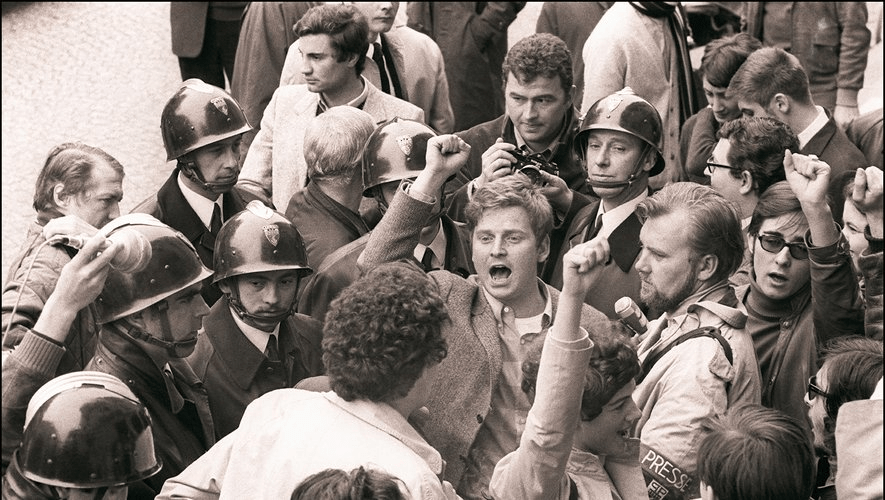
The interview between Sartre and Cohn-Bendit encapsulated a moment in French history where
intellectuals used modern forms of medium to extract philosophy from lecture halls and released it
onto the streets. To achieve rhetoric through the medium of the press, the abstract notions of
reflection and engagement were performed on the streets to the people. By embracing parrhesia,
Sartre’s responsibility as an intellectual was demonstrated through the publicity of his dialects and
discussions amid the political tension. A cultural shift was emphasised the change in role of an
intellectual as a performer, mediator and participant in a philosophical collective experience, due to
the dialogue’s immediacy and accessibility. Ultimately, Sartre’s interview with Cohn-Bendit
redefined the role of a modern intellectual from an interpreter to a public champion and mediator
for collective discourse, divulging that freedom, for both thinkers and citizens alike, is only
achievable through the risk of public expression.
Appendix
Fig. 1: Unknown creator, 1968. Riots, Paris May 1968 [image]. Available at:
https://communist.red/the-french-revolution-of-may-1968/ [Accessed 3 November 2025].
Fig. 2: Unknown creator, 1968. The occupied Sorbonne, May 1968 [image]. Available at:
https://libcom.org/article/sorbonne-anarchist-leaflet-1968 [Accessed 3 November 2025].
Fig. 3: Unknown photographer, 1974. Jean-Paul Sartre and others at a press conference [image].
19688691.me [online]. Available at: https://19688691.me/2018/08/26/interview-with-sartre-may
20-1968/ [Accessed 3 November 2025].
Fig. 4: Le Nouvel Observateur, 1968. Cover showing student protests, May 1968 [magazine cover].
Available at: https://www.abebooks.com/magazines-periodicals/nouvel-Observateur
N%C2%B01746-avril-1998-Mai/31677261573/bd [Accessed 3 November 2025].
Fig. 5: POLITICO, 1968. Daniel Cohn-Bendit photographed amongst fellow protestors [image].
Available at: https://www.politico.eu/wp-content/uploads/2016/09/GettyImages-148084833
714×479.jpg [Accessed 3 November 2025].
Further reading
Sartre, J.-P. and Cohn-Bendit, D., 1968. Interview in Le Nouvel Observateur, 20 May. Translated by
Brewster, B.R. (from the French original published in Les Temps Modernes, 1968). Reproduced in
Verso Books Blog, available at: https://www.versobooks.com/en-gb/blogs/news/3819-jean-paul
sartre-interviews-daniel-cohn-bendit?srsltid=AfmBOora2tGTRcnrBqJvb8K4
NMx8vpMtlUoJxcCaVw4f9XggV_3ZBfL [Accessed 2 November 2025].
Andrew M., 2016. Jean Paul Sartre interviews Daniel Cohn-Bendit. Translated by Brewster, B.R.
(from the French original published in Les Temps Modernes, 1968). Medium [online]. 29 October.
Available at: https://medium.com/@AM_HC/jean-paul-sartre-interviews-daniel-cohn-bendit
5cd9ef932514 [Accessed 3 November 2025].
INA Société., 2012. Daniel Cohn-Bendit “Jean-Paul Sartre and May 68” | INA Archive [online video].
Available at: https://www.youtube.com/watch?v=mgnLNkSHMC8 [Accessed 2 November 2025].
Sartre, J.-P., 1943. L’Être et le Néant [online]. Available at:
https://classiques.uqac.ca/classiques/Sartre_jean_paul/etre_et_neant/etre_et_neant.html
[Accessed 1 November 2025].
Boschetti, A., 1985. Sartre et “Les Temps modernes” : une entreprise intellectuelle. Paris: Editions de
Minuit [online]. Available at:
https://archive.org/details/sartreetlestemps0000bosc/page/16/mode/2up [Accessed 3 November
2025].
Zola, É., 1898. J’accuse…! [online]. Available at: https://www.britannica.com/topic/Jaccuse
[Accessed 1 November 2025].
Barthes, R., 1977. Image, Music, Text. Translated by S. Heath. [pdf] Monoskop. Available at:
https://monoskop.org/images/0/0a/Barthes_Roland_Image-Music-Text.pdf [Accessed 1 November
2025].
Sartre, J-P., 1946. L’existentialisme est un humanisme [online]. Available at:
https://psychaanalyse.com/pdf/L%20EXISTENTIALISME%20EST%20UN%20HUMANISME%20-%20JE
AN-PAUL%20SARTRE%201970%20(14%20Pages%20-%20106%20Ko).pdf [Accessed 1 November
2025].
Bjork-James, C., 2023. ‘Jean-Paul Sartre on his own anarchism’ [Blog]. Carwil without Borders.
Available at: https://woborders.blog/2023/01/08/sartre-on-anarchism/ [Accessed 2 November
2025].
Sartre, J. P., 1974. Extrait d’une interview accordée par Claude Lanzmann, in Jean-Paul Sartre et «
Les Temps modernes » (Sciences Po PDF), [Accessed 2 November 2025].
Silvera, A., 1971. The French Revolution of May 1968. The Virginia Quarterly Review, 47(3), pp.336 Available at:
https://www.jstor.org/stable/26443428?searchText=may+1968&searchUri=%2Faction%2FdoBasicS
earch%3FQuery%3Dmay%2B1968%26so%3Drel&ab_segments=0%2Fspellcheck_basic_search%2Fte
st&refreqid=fastly-default%3Afda28da5f9468a0cad3b42f04e3fa404&seq=6 [Accessed 3 November
2025].
Orain, M., 2018. Changing modes of intervention of the French intellectual from the Dreyfus affair
to today; Sartre, Lévy, Hessel. [PhD thesis] Birkbeck College, University of London. Available at:
https://eprints.bbk.ac.uk/id/eprint/40347/1/PhD_thesis_Marine_Orain.pdf [Accessed 4 November
2025].
Foucault, M., 1982–1983. The Government of Self and Others: Lectures at the Collège de France,
1982–1983. Translated by Graham Burchell. Edited by Arnold I. Davidson. New York: Palgrave
Macmillan. Available at: https://ftp.uoh.edu.iq/admin/ebooks/82331-michel-foucault-the
government-of-self-and-others-lectures-at-the-college-de-france,-1982-1983—-2010.pdf [Accessed
4 November 2025].
Cohn-Bendit, D. and Cohn-Bendit, G., 1968. Obsolete Communism: The Left-Wing Alternative [e
book]. Translated by A. Pomerans. London: André Deutsch Ltd. Available at:
https://files.libcom.org/files/Obsolete%20Communism%20-%20The%20left
wing%20alternative%20-%20Daniel%20Cohn-Bendit%20&%20Gabriel%20Cohn-Bendit.pdf
[Accessed 3 November 2025].
Cohn-Bendit, C. and Schmid, L., 1997. Une paralysie bien française: Entretien avec Daniel Cohn
Bendit. Espirit, No. 236 (10) (Octobre 1997), pp. 33-46 (14 pages). Available at:
https://www.jstor.org/stable/24276857 [Accessed 2 November 2025].
Even further reading
Crouzet, F., 1969. A University Besieged: Nanterre, 1967-69. Political Science Quarterly, Vol. 84, No.
2 (Jun., 1969), pp. 328-350 (23 pages). Available at: https://www.jstor.org/stable/2147263
[Accessed 2 November 2025].
Jobs, R. I., 2009. Youth Movements: Travel, Protest, and Europe in 1968. The American Historical
Review, Vol. 114, No. 2 (Apr., 2009), pp. 376-404 (29 pages). Available at:
https://www.jstor.org/stable/30223784 [Accessed 2 November 2025].
Bourg, J., 2007. From revolution to ethics : May 1968 and contemporary French thought. Montreal
[Que.]: McGill-Queen’s University Press. Available at: https://doi.org/10.1515/9780773576216
[Accessed 2 November 2025].
Bologna, S. & Daghini, G., 2018. May ’68 in France (1968). Viewpoint Magazine, 21 June. Available
at: https://viewpointmag.com/2018/06/21/may-68-in-france-1968/ [Accessed 4 November 2025].
Goulard, H., 2016. Q&A avec Dany Cohn-Bendit. POLITICO Europe, 7 September. Available at:
https://www.politico.eu/article/interview-daniel-cohn-bendit-populisme-nationalisme
presidentielles/ [Accessed 3 November 2025].
Woods, A., 2018. The French Revolution of May 1968. The Communist. Available at:
https://communist.red/the-french-revolution-of-may-1968/ [Accessed 3 November 2025].
La Dépêche, 2008. La Sorbonne, Bastille de mai 68. La Dépêche, 21 March. Available at:
https://www.ladepeche.fr/article/2008/03/21/444175-la-sorbonne-bastille-de-mai-68.html
[Accessed 3 November 2025].
Dyrberg, T. B., 2016. Foucault on “parrhesia”: The Autonomy of Politics and Democracy. Political
Theory, 44(2), pp. 265-288. Available at:
https://www.jstor.org/stable/24768039?searchText=foucault+parrhesia&searchUri=%2Faction%2F
doBasicSearch%3FQuery%3Dfoucault%2Bparrhesia%26so%3Drel&ab_segments=0%2Fspellcheck_b
asic_search%2Ftest&refreqid=fastly-default%3Ae3e40994aaf49c9ebe664caec93f5a2c&seq=1
[Accessed 4 November 2025].
 Intellectuals and the Media in France