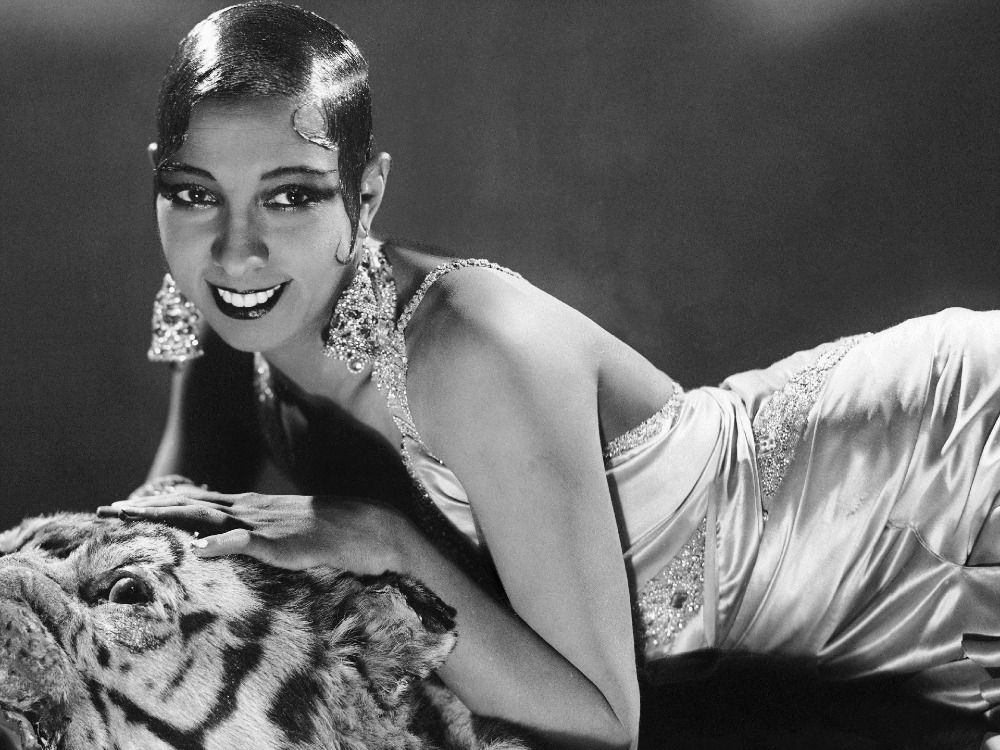
‘An intellectual is a person who engages in critical thinking, research, and reflection about the reality of society, and who proposes solutions for its normative problems’.[i] Although, who does this entail? Is this definition referring exclusively to those who make an intervention in the public sphere or those who possess specialist knowledge or rather, those responsible for investigating responses into complex questions? Arguably, the determining factor to be considered a public intellectual is the degree in which the individual is implicated with the reality of the contemporary world.
Joséphine Baker (1906 – 1975) was an American-born French internationally recognised dancer, singer, and actress as well as a civil rights activist and spy. On November 30th, 2021, Baker was inducted into France’s Pantheon. Alongside renowned intellectuals, including Voltaire, Émile Zola and Aimé Césaire, Baker became the fifth woman and the first black woman to enter this secular temple. Similarly, to becoming an intellectual, there is no definitive criteria as to who gets this honour and although her pantheonisation has often produced a one-dimensional image in the media, it was certainly more than Baker’s pretty face and good voice that landed her this prestige.
Arguably, Baker stood at the intersection of major artistic and cultural movements of the mid-twentieth century and raised critical questions about race, gender and postcolonial history however, this is often inaccurately reflected in the media. Whilst the dancer most notably expressed herself through image and choreography, some of the concepts behind her performances have been undermined by reductive stereotypes and voyeuristic representation. Moreover, it can be argued that through her chosen medium of dance, she responded to complex ideas by humanising concepts, including womanhood and self-expression, Black Consciousness and universal brotherhood. Can Baker thus be classified as an intellectual? Was she the intellectual of the people?
La danse pourrait être « une métaphore de la pensée »
In parallel with literature, dance plays a special role in the production of social and cultural identity. For some critics and theorists, including Jacques Derrida, dance as a cultural and artistic form of expression challenges static notions of identity by disrupting conventional binary constructions of the self. It can be said that although Baker has been somewhat mis-represented in the media, she humanised Derrida’s ideology by positioning herself as a kind of iconic signifier of identity ‘in the process of becoming rather than being’ (Hall 1996).

As stated in Macron’s speech, Baker had ‘une certaine idée de la liberté, de la fête’, however, similarly to her portrayal in the media, this description simplifies her influence. The poster below depicts her as the star of Paris surrounded by shallow objects – oversized pearls and flamboyant feathers. She has been arguably objectified and trivialised through the artist’s work, primarily due to her lack of clothes but also through the use of colour. The use of red and soft pinks draw attention to the sensuality and vivacity of Bake r’s performances, painting her as this figure of desire thus diminishing the intellectual voice behind her image. When examining the poster below, our percieved affordance views the work as both an advertisement for la Danse Sauvage but also as a cultural artefact starring Baker as the central image, highlighting Baker’s marketability. Lithographic posters were a popular technique in the 1920’s and 1930’s in Paris to advertise theatrical performances and in order to further promote the dance, the artist deploys visual and textual rhetoric by exaggerating her famous smile and radiant energy to help feed into her allure which was central to her brand and appeal.
The text reinforces her reputation, calling her ‘l’idole des foules’, playing on her mass appeal and charismatic ability to engage with the contemporary world. The use of anaphora and hyperbole in the paratext serves a persuasive function to entice its audience which, when used alongside her provocative image, highlights the marketability of Baker and thus the exoticism of non-European performers. This arguably trivialises the complex ideas in which Baker stood for.
As implied by Alan Badiou and his work on the philosophy on dance, Baker’s work and life have challenged the interpretation of performance as a pure form of resistance by introducing the ambiguities of cultural ambivalence[ii]. Although Baker’s true impact was often undermined through her media portrayal, she was nevertheless able to engage with her audience in a more tangible way. Richard Posner (2006: 85) asserts that the life of the public intellectual is a ‘charismatic calling’. He stresses that the intellectual is comprised of more than just ‘intelligence’, but rather is someone who can make complex ideas more tangible for the general public (2006: 85). Is this not arguably what Baker does?
‘…not just a pretty face and a good voice’

An underlying key feature behind her performances was that ‘Baker belonged to no-one’. In a similar way to Simone de Beauvoir, she had a clear vision of liberty and exercising that liberty. The following image offers us a glimpse into how the media plays a role in shaping gender and colonialist stereotypes. Sexualised and objectified images of women in the media have been contributing to women’s second-class status in society (Carter 2014: 370). Figure 2 captures Baker in an intimate backstage moment. The photograph uses both the mirror and Baker’s direct form, creating a layered composition in which the rhetorical power of the image lies in its use of reflection and gaze.
Although differing in the chose of medium, both figures 1 and 2 present Baker as something marketable, something to be desired, thus undermining the complex concepts behind her dances. The presence of the spectator in the background brings into view and therefore into consciousness, the male gaze critical to the poses in Baker’s early photographs. The photographer’s position (capturing her reflection rather than a direct portrait) enhances the rhetorical message but further introduces an objectifying, voyeuristic element, as though she is perpetually observed. In an article published by Jane Nardal in La revue du monde noir, Baker was denounced for indirectly promoting stereotypes. Nadal argued that Baker’s self-portrayal contributed to degrading stereotypes towards the Black Community with the photo reflecting ‘the obsessive need of the colonizer to “look” and the obsessive desire of the colonized to be “looked at”’. However, was this just a case of Baker expressing her free will and embodiment of womanhood? Has she been yet again mis-represented by the media?
Behind her voyeuristic representation, Baker’s vision closely follows Jean-Paul Sartre’s dialectic of Négritude in which Négritude is an affirmation of blackness. In their various versions of the concept, Aimé Césaire, Léopold Sédar Senghor and Léon Damas all emphasise the antithetical moment in the dialectic as an assertion of cultural pride, providing a basis for black participation in universal harmony. In the case of Baker it was performative rather than literary and philosophical, however, nevertheless, Baker’s primal image shared much in common with Négritude’s essentialism. She just delivered her ideas a more provocative and therefore tangible way, arguably rendering her as the people’s intellectual.
The people’s intellectual?
Joséphine Baker’s cultural legacy is still alive beyond the hundredth anniversary of her birth. It exists in live performances, art, photography, fashion, film, literature and social activism. Whilst not traditionally in line with conventional definitions of an intellectual, it can be said that Baker encompasses Michel Foucault’s idea that a complex message can be simple and provocative in its delivery[iii]. At the conclusion of his discussion of Richard Wright in The Black Atlantic, Paul Gilroy asks: ‘what would it mean to read Wright intertextually with Genet, Beauvoir, Sartre, and the other Parisians with whom he was in dialogue?’ (Gilroy 1993: 186). It can be said that Baker also needs to be ‘read’ intertextually with its concepts of universalism, ideals of assimilation, and utopian visions of liberty, equality and fraternity arguing that she is indeed an intellectual.
Although her image is often undermined in the media, it can be said that the concepts and visions behind her dances serve as antecedents to the work of other intellectuals, most notably Beauvoir and Césaire. Moreover, through her chosen medium, Baker is able to humanise these complex ideas, thus rewarding her, her status as the people’s intellectual.
Appendix
Figure 1: https://auctions.posterauctions.com/lots/view/1-465CCT/josephine-baker-la-folie-du-jour-ca-1927
Figure 2: Lipnitzki, H. (1930) Joséphine Baker [Photograph]. Photographique Roger-Viollet
Further Reading
Anne Anlin Cheng (2010). Second Skin. Oxford University Press.
Bennetta Jules-Rosette (2007). Josephine Baker in art and life: the icon and the image. Urbana: University Of Chicago Press.
Bullock, A., Trombley, S. and Lawrie, A. (1999). The New Fontana Dictionary of Modern Thought. 3rd ed. London: Harpercollins.
Carter, C. (2014). Sex/Gender and the Media: From Sex Roles to Social Construction and Beyond, in Ross, K. (ed.) The Handbook of Gender, Sex, and Media. Chichester: Wiley Blackwell.
Clark, J.O. (2011). Dance and Subtraction: Notes on Alain Badiou’s Inaesthetics. Dance Research Journal, 43(2), pp.50–64. doi:https://doi.org/10.1017/s0149767711000052.
Derrida, J. and Weber, E. (1995). Points... Stanford.: Stanford University Press.
Fischer-Hornung, D. and Goeller, A.D. (2003). Embodying liberation : the black body in American dance. Mun̈ster ; London: Lit.
Hall, S. (1996). Questions of Cultural Identity. London; Thousand Oaks, California: Sage Publications Ltd.
Henderson, M. G. (2003) ‘Josephine Baker and La Revue Negre: from ethnography to performance’, Text and Performance Quarterly, 23(2). doi: 10.1080/1046293032000141338.
Jules-Rosette, B. (2005). Josephine Baker and utopian visions of Black Paris. Journal of Romance Studies, 5(3). doi:https://doi.org/10.3167/jrs.2005.050304.
Michel Foucault, Le Courage de la vérité (Paris: Gallimard / Le Seuil, 2009)
Posner, R. (2006). Public intellectuals: A Study of Decline. 2nd ed. Cambridge, Mass.: Harvard University Press.
Raphael-Hernandez, H. (2012). Blackening Europe. Routledge.
[i] Bullock, A., Trombley, S. and Lawrie, A. (1999). The New Fontana Dictionary of Modern Thought. 3rd ed. London: Harpercollins. p. 433.
[ii] Clark, J.O. (2011). Dance and Subtraction: Notes on Alain Badiou’s Inaesthetics. Dance Research Journal, 43(2), pp.50–64.
[iii] Michel Foucault, Le Courage de la vérité (Paris: Gallimard / Le Seuil, 2009), p.14.
 Intellectuals and the Media in France