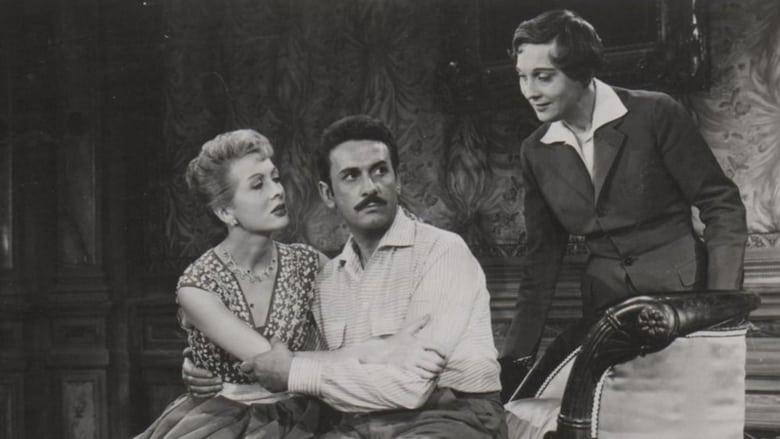
In his 1948 essay “Qu’est-ce que la littérature?,” Jean-Paul Sartre states that “il faut apprendre à parler en images, à transposer les idées de nos livres dans ces nouveaux langages”1 when discussing alternative forms of communication, like radio and television, becoming more widespread in the mid-twentieth century. Could one consider Sartre’s earlier plays an example of using a ‘nouveau langage’ to convey his ideas, engaging with a different form of media? In his plays, Sartre manages to imbue his scripts and characters with underlying themes based on his Existentialist philosophy. In Huis Clos, Sartre’s 1944 play, Existentialist themes of freedom, mauvaise foi, and essence permeate the play, inadvertently educating the audience on core Existentialist ideas, as well as providing a cautionary tale.
Is Theater Media?
In order to claim that Huis Clos is an example of Sartre engaging with the media, one must argue that theater is a form of media. Unlike with radio or television, traditional models of communication do not encompass theater’s scope, as it is more than just the simple communication of messages. Marshall McLuhan, famous for his work in media studies, believed that ‘the medium is the message,’ or that any media is something that affects the audience.2 In Huis Clos, Sartre uses the media of theater to illustrate his thoughts on key Existentialist ideas, and how they can affect the human condition, calling the audience to action through this cautionary tale.
The Tale of Huis Clos
Huis Clos premiered in May 1944 at the Théâtre du Vieux-Colombier in Paris, featuring only three characters: Garcin, Inès, and Estelle. The three find themselves locked in a small Second Empire-style drawing room in Hell. At first, none of them will truly admit to the reason they have arrived in Hell as they realize they appeared in the same room to torture one another for eternity. The characters are thus forced to interact with each other, giving context to many of Sartre’s Existentialist views. In addition to exploring themes of Existentialism, the play also gives rise to one of Sartre’s famous quotes, “l’enfer, c’est les autres.”3
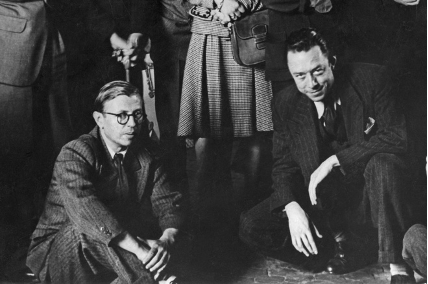
Albert Camus, pictured above, was one of the original inspirations (alongside sisters Olga and Wanda Kosakiewicz) for Huis Clos, and was originally meant to direct and star as Garcin. The play was meant to be short, have only one set, and very few characters.4 Published immediately post-World War II, the situation of the three characters mirrors those trapped in a cellar during a bombing raid, a prison, or a hospital – all forced “to live (so to speak) in compulsory cohabitation.”5 At the time, censorship was still present in theater. This governed what could be said on the stage, an obstacle Sartre had to work around so his Existentialist ideas could reach the stage, and the masses. Furthermore, because of curfews in place and the limited resources available in post-war France, a short play with only one setting became beneficial.6 The idea from Camus, Barbezat, and Kosakiewicz allowed for Sartre to work around the many barriers in place so that Huis Clos, and its messages, could reach the world.
The Existentialism of Huis Clos
Huis Clos is about the interactions of the condemned characters with one another, giving context to Sartre’s thoughts on relationships and one’s freedom of choice. As the characters are forced to interact in the drawing room for eternity, the audience is forced to watch their repeated demonstrations of mauvaise foi (bad faith; denying one’s truth by rejecting their freedom of choice and responsibility) and cowardice, gaining perspective on major transgressions of Existentialist philosophy.
In order to completely portray all his philosophies in such a short amount of time, Sartre incorporates his Existentialist philosophies into the props of Huis Clos. Most notably, a paper knife is present, the object famous in defining Sartre’s idea of ‘existence preceding essence’ in his 1945 lecture “L’existentialisme est un humanisme.” But here, the paper knife cannot fulfill its role of cutting paper as no books or paper are present in the room. Its other purpose, as a weapon, is proven non-existent when Estelle tries to kill the dead Inès.7 Sartre demonstrates here how he does not believe in an afterlife by making the knife lose its essence; therefore, it does not technically exist.8
Throughout the play, Garcin, Inès, and Estelle demonstrates Sartre’s own thoughts on mauvaise foi. Each character hides behind a mask they use to excuse their fixed essences. Garcin hides his cowardly nature behind his hyper-masculinity, telling stories about his affair and violence against his wife in order to seem strong.9 His cowardly nature comes to a head when, faced with the open door, he is overcome by fear and his cowardice becomes known as he cannot assume the responsibility of his choices.10 Next, Estelle’s mauvaise foi lies in her self-obsession and fear of judgment. In a room without mirrors, Estelle allows Inès to act as her ‘mirror’ and re-define the way she looks, and her essence.11 Finally, Inès’ ‘bad faith’ lies in the fact that she believes her sadistic and torturous personality cannot be changed, avoiding the freedom to make better choices.12

The interactions of the characters all together provide another example of Sartre’s idea of le regard, or self-consciousness; ultimately, le regard is an underlying theme that affects all of the character’s interactions with one another because each fears the judgement of the others. The interactions between three characters specifically chosen to torture one another for eternity show us what Sartre meant by “l’enfer, c’est les autres,” as the audience begins to recognize that their repeated mistakes and examples of ‘bad faith’ drive the characters into a spiral of lies and despair.
Sartre’s play gives an example of how ‘bad faith’ and pressures from le regard ultimately provide the audience with a warning of the misery that can become of those who deny humanity’s inalienable freedom, cornerstone Existentialist philosophies. Premiered directly after World War II, Huis Clos also provides an important message at the time. In response to negative views from right-wing newspapers, Benedict O’Donohoe notes, “we must infer that Sartre had hit a nerve, and that the play’s clear lesson, that ‘your sins will find you out’, was an uncomfortable message for all those who had thrown their lot with the Teutonic conqueror.”13 By engaging with theater as a form of media, Sartre was able to spread his Existentialist philosophies present in Huis Clos to an incredibly wide audience, demonstrating his strong grasp on the ‘nouveaux langages’ that exist outside of literature.
Appendix
Figure 1: Brassaï. (1944) Portrait de groupe, atelier des Grands-Augustins à Paris. Available at: https://www.photo.rmn.fr/archive/19-501856-2C6NU0ACW7G0K.html (Accessed 29 October 2024).
Figure 2: “Arletty, Gaby Sylvia, and Frank Villard in No Exit (1954),” Jacqueline Audry, No Exit, 1954. Available at: https://www.imdb.com/title/tt0047099/mediaviewer/rm65251585/?ref_=tt_mi_3 (Accessed 29 October 2024).
Further Reading
Balme, C.B. (2008). The Cambridge Introduction to Theatre Studies.Cambridge, UK: Cambridge University Press. Available at: https://doi.org/10.1017/CBO9780511817021.
Beauvoir, S.d. (1960). La Force de l’âge. Paris: Gallimard.
Bernasconi, R. (2006). How to Read Sartre. London: Granta Books.
Gillespie, J. (2012). ‘Sartre and Theatrical Ambiguity’, Sartre Studies International, 18(2), pp.49-58. Available at: https://doi.org/10.3167/ssi.2012.180203.
McCall, D. (1969). The Theatre of Jean-Paul Sartre. New York: Columbia University Press.
McLuhan, M. (2003). Understanding Media: the Extensions of Man. Critical edition. Corte Madera, CA: Gingko Press.
O’Donohoe, B. (2005). Sartre’s Theater: Acts for Life. Oxford: Peter Lang.
Pauly, R.M. (1987). ‘Huis clos, Les Mots et La Nausée: le bronze de Barbedienne et le coupe-papier’, The French Review, 60(5), pp. 626–634.
Redfern, W.D. (1995). Sartre: Huis clos and Les Séquestrés d’Altona. London: Grant & Cutler.
Ridge, G.R. (1957). ‘Meaningful Choice in Sartre’s Drama’, The French Review, 30(6), pp. 435–441.
Sartre, J.-P. (2009). Huis clos: suivi de Les mouches. Paris: Gallimard.
Sartre, J.-P. (1957). Being and Nothingness: an Essay in Phenomenological Ontology. London: Methuen & Co. LTD.
Sartre, J.-P. (1947). Qu’est-ce que la littérature? Paris: Gallimard.
Senejani, A.A. (2013) ‘Sartre’s Existentialist Viewpoint in No Exit’, International Journal on Studies in English Language and Literature 1(3), pp.15-23.
Villani, S. (2023) ‘Towards a Phenomenology of Reflective Identification: Huis Clos’ Mirror Theme’, Sartre Studies International, 29(2), pp. 36–5. Available at: https://doi.org/10.3167/ssi.2023.290204.
References
- Sartre (1947), p. 266. ↩︎
- McLuhan (2003), pp. 7-23. ↩︎
- Sartre (2009), p. 93. ↩︎
- Beauvoir (1960), p. 444. ↩︎
- Redfern (1995), p. 14. ↩︎
- Senejani (2013), pp.15-23. ↩︎
- Sartre (2009), p. 94. ↩︎
- Pauly (1987), pp. 631-633. ↩︎
- Sartre (2009), p. 94. ↩︎
- Sartre (2009), pp. 86-88. ↩︎
- Sartre (2009), p. 48. ↩︎
- Sartre (2009), p. 48. ↩︎
- O’Donohoe (2005), pp. 73-74. ↩︎
 Intellectuals and the Media in France